Circlewise: The AI-Powered Village for Modern Parenting 🌿
An AI-powered platform design assisted by AI
Overview
They say it takes a village to raise a child. But in the modern world, that village is often scattered, digital, and overwhelmingly noisy.
For working parents of early school-age children, managing developmental growth isn’t easy; it’s about logistics, filtering information, and finding people who actually get it.
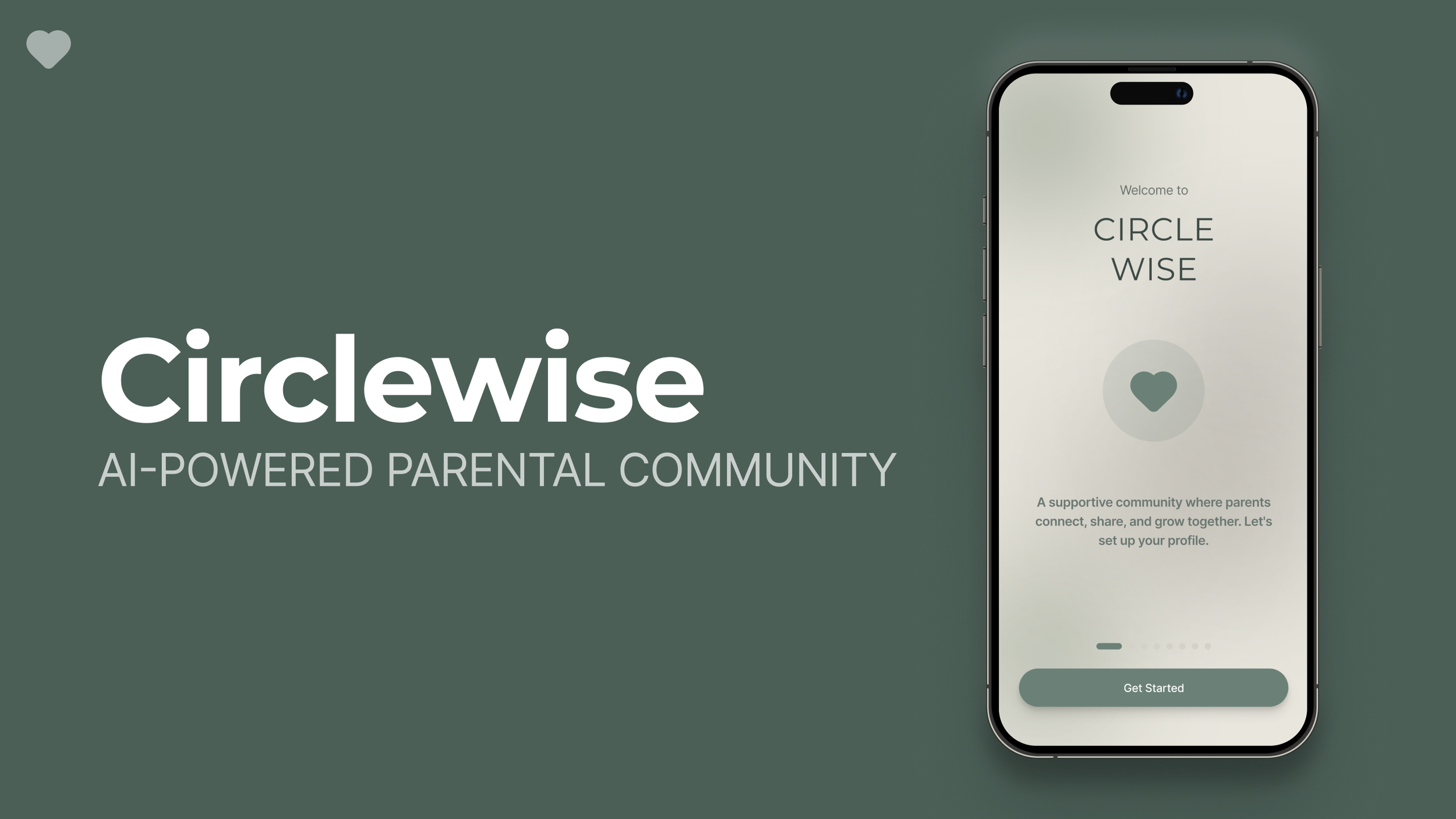
Circlewise is an AI-powered platform designed to rebuild that village. It connects parents to trusted, personalized networks, using AI not to replace human connection, but to curate and protect it.
Team: 3 UX Designer & Researcher
Timeline: October - December, 2025
Methods & Tools: User Interview - NotebookLM, Interactive Persona - Claude & Character ai., AI Co-Creative Design - Deepseek & Chatgpt, Rapid Prototyping - Figma & Figma Make
Key Stakeholders: Parents, caregivers, families, community moderators, product teams, and AI safety experts.
Defining the Problem
Navigating the noise of modern parenting
Parents today are drowning in advice. From Google searches to chaotic WhatsApp groups, the challenge isn’t finding information, it’s finding relevant and trustworthy support.
Our team focused on a specific, high-pressure demographic: working parents managing the complex developmental shift of early school-age children.
This led us to our core problem statement:
“How might AI support working parents with early school-age children in managing their children’s developmental and educational growth?”
Initial Research
How do we find out what working-parents really need?
To find the answer, we moved beyond assumptions and conducted in-depth 1:1 interviews with three distinct parent archetypes to cover a spectrum of attitudes toward technology:
The Digital Realist (Participant 1): A single working mother navigating the chaos of raising a tech-influenced child while managing her own reliance on digital tools.
The Values-Driven Guardian (Participant 2): A religious mother balancing faith and emotional care, struggling with fatigue and looking for thoughtful, low-noise technology.
The Anti-Device Strategist (Participant 3): A parent strictly focused on screen-free routines and building executive function skills, skeptical of AI’s role in her child’s life.
Synthesis Results
We synthesized our interview data through affinity mapping
We clustered pain points around trust, time, and advice overload. We then used NotebookLM to synthesize our 3 transcripts to see overlap and differences between the two analyses to reach our final findings.
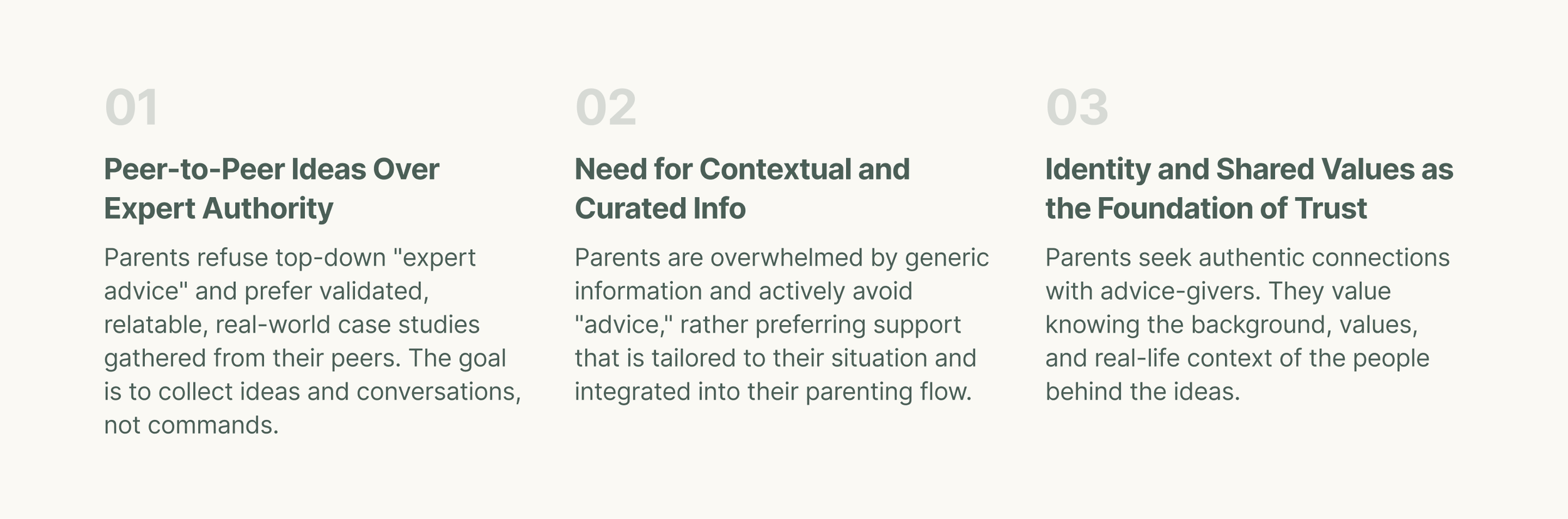
This process revealed three critical insights that defined our product direction:
Interactive Persona:
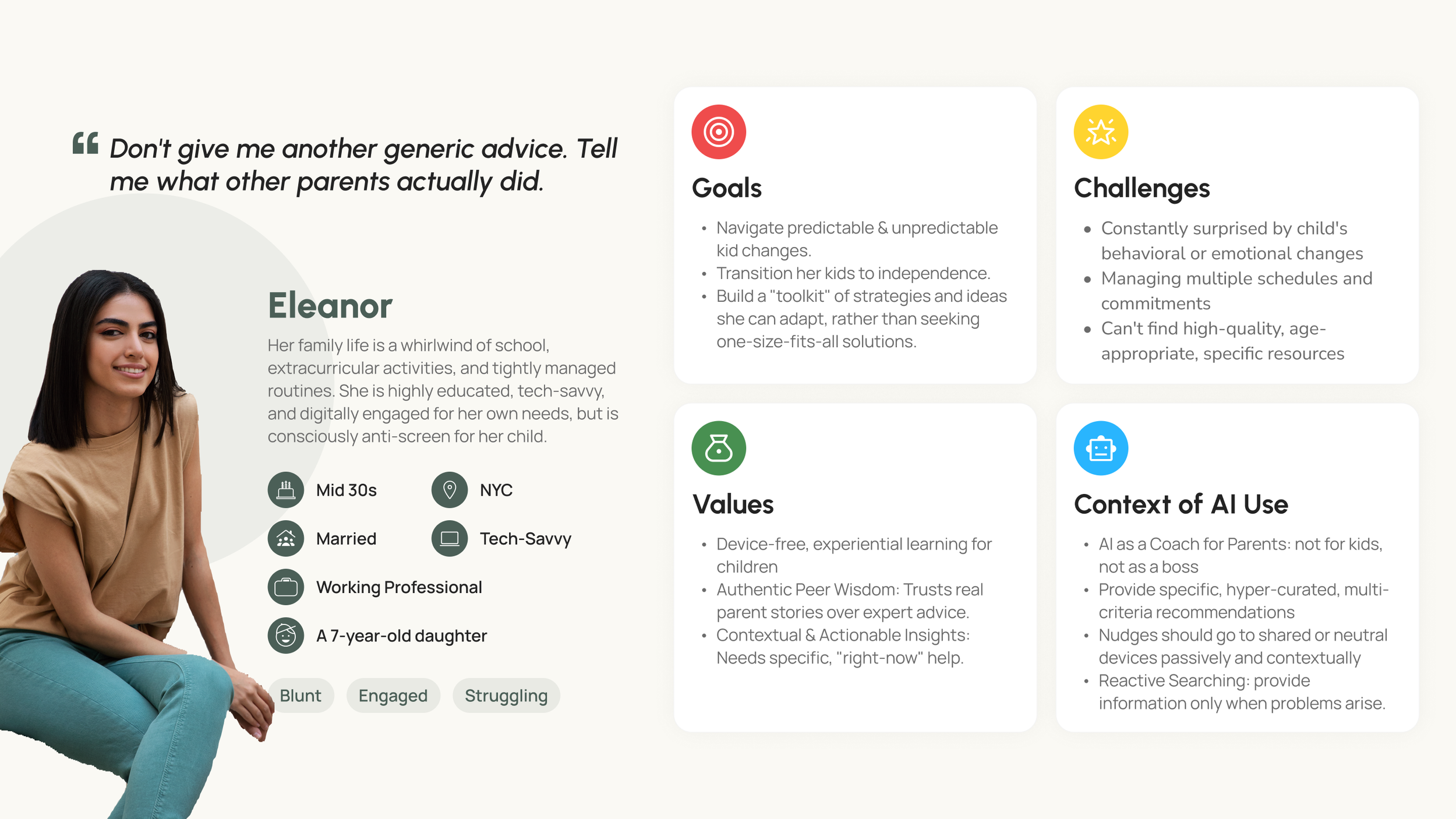
“Don’t give me another generic advice. Tell me what other parents actually did.”
From these insights, we built our interactive persona, Eleanor. She isn’t just a user; she’s a strict filter for our feature set.
Initial Ideation
Turning Insights into Design Implications
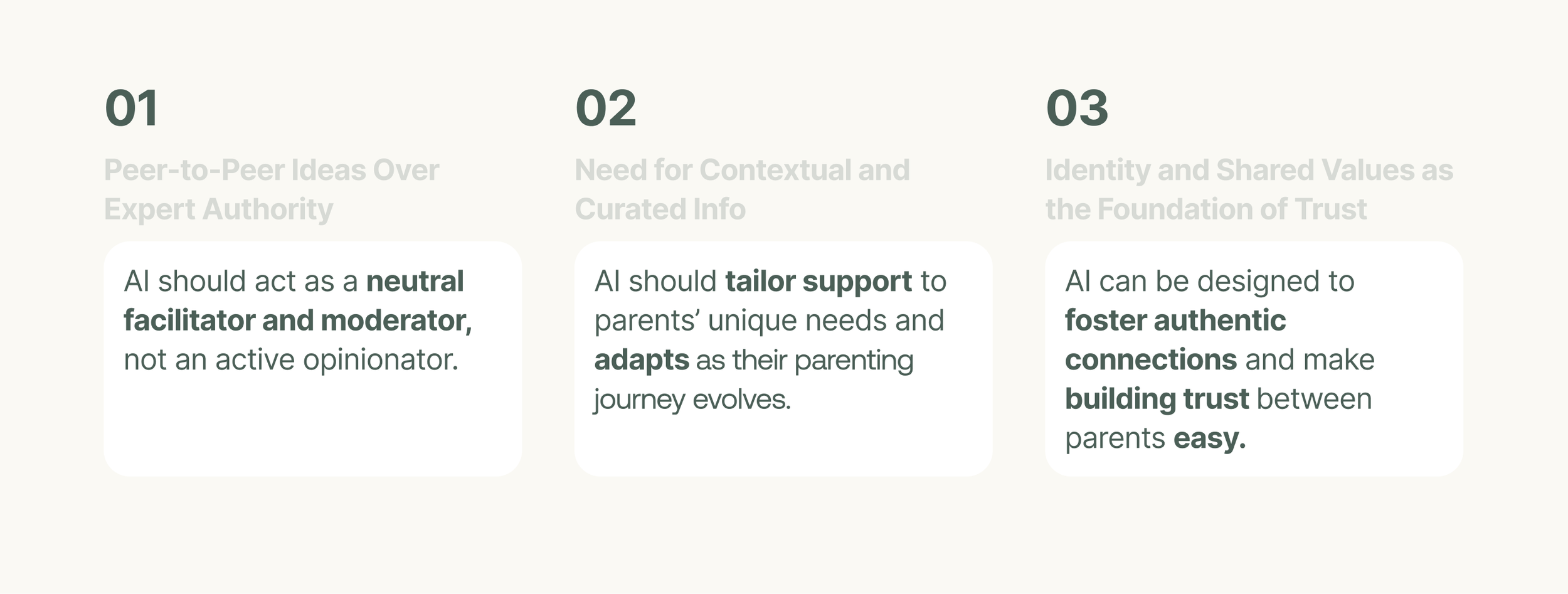
Moving beyond a “Chatbot”
In our early ideation, we realized that a simple AI chatbot wasn’t enough. Parenting is inherently social. A bot can give facts, but other parents give wisdom.
We pivoted from an “AI Advisor” model to an “AI Facilitator” model. We decided the AI’s role should be to:
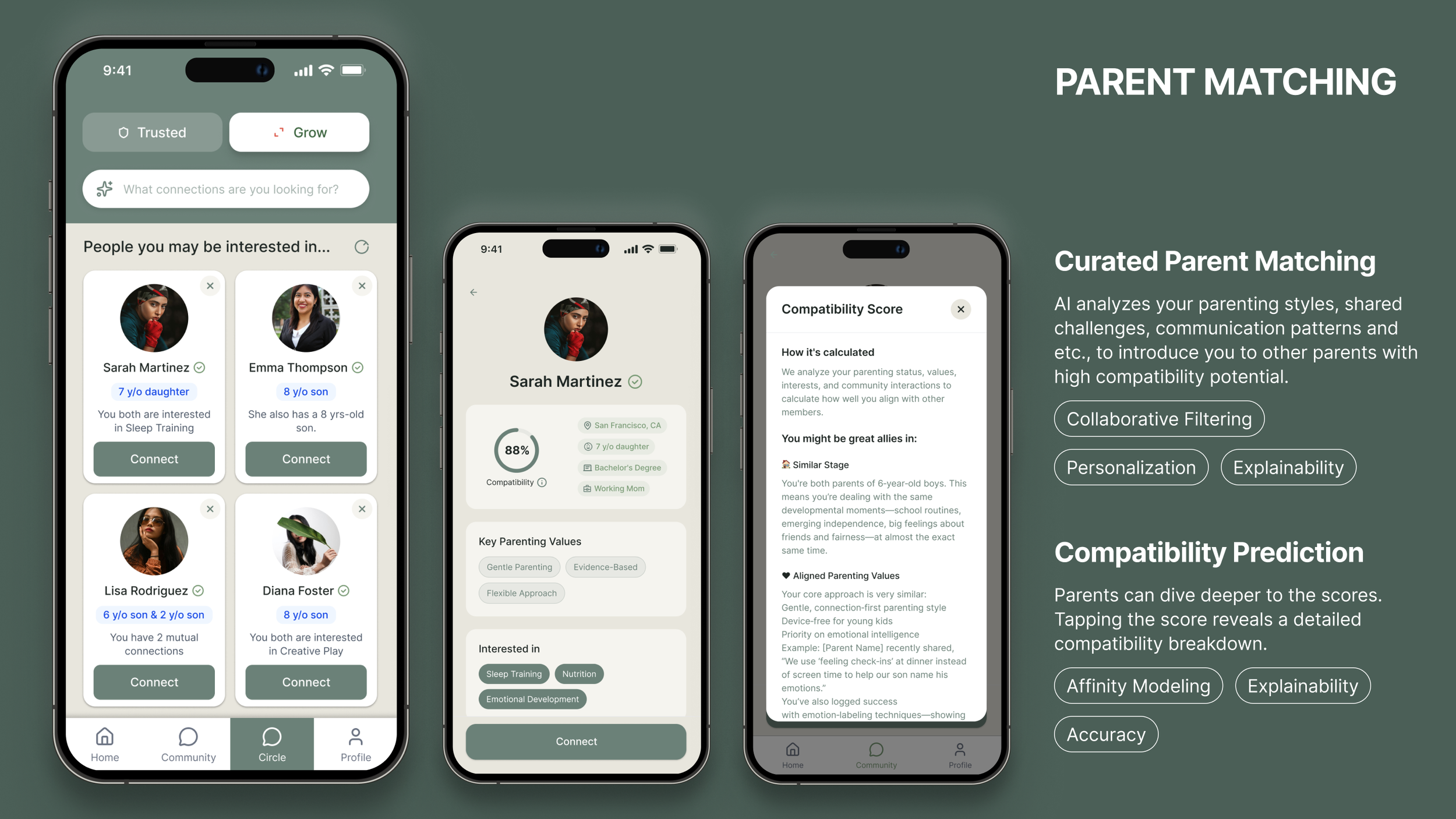
Curate the community (matching parents with similar values).
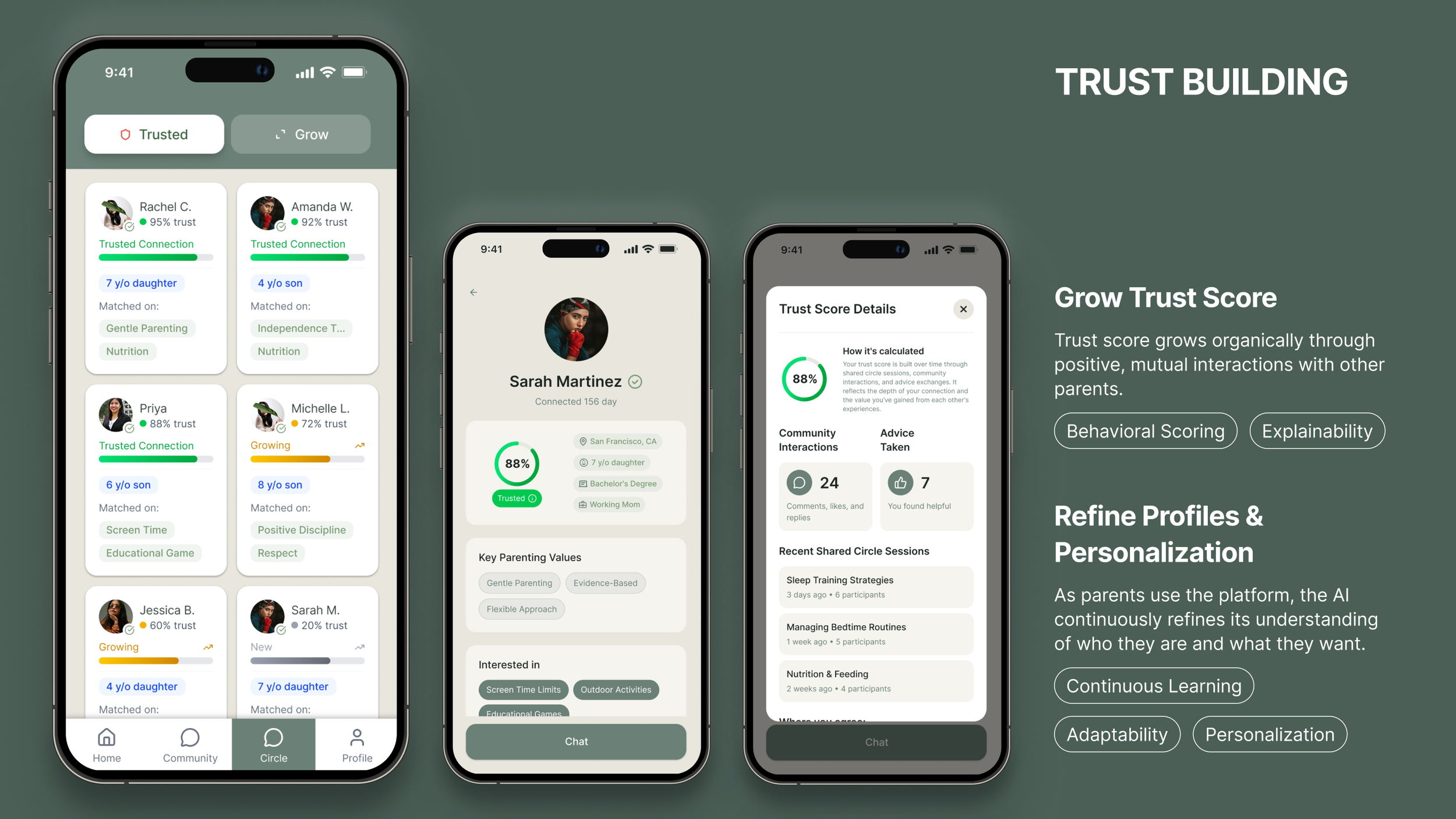
Quantify trust (helping parents vet connections).
Personalize the growth journey (adapting as the child ages).
Initial Sketches
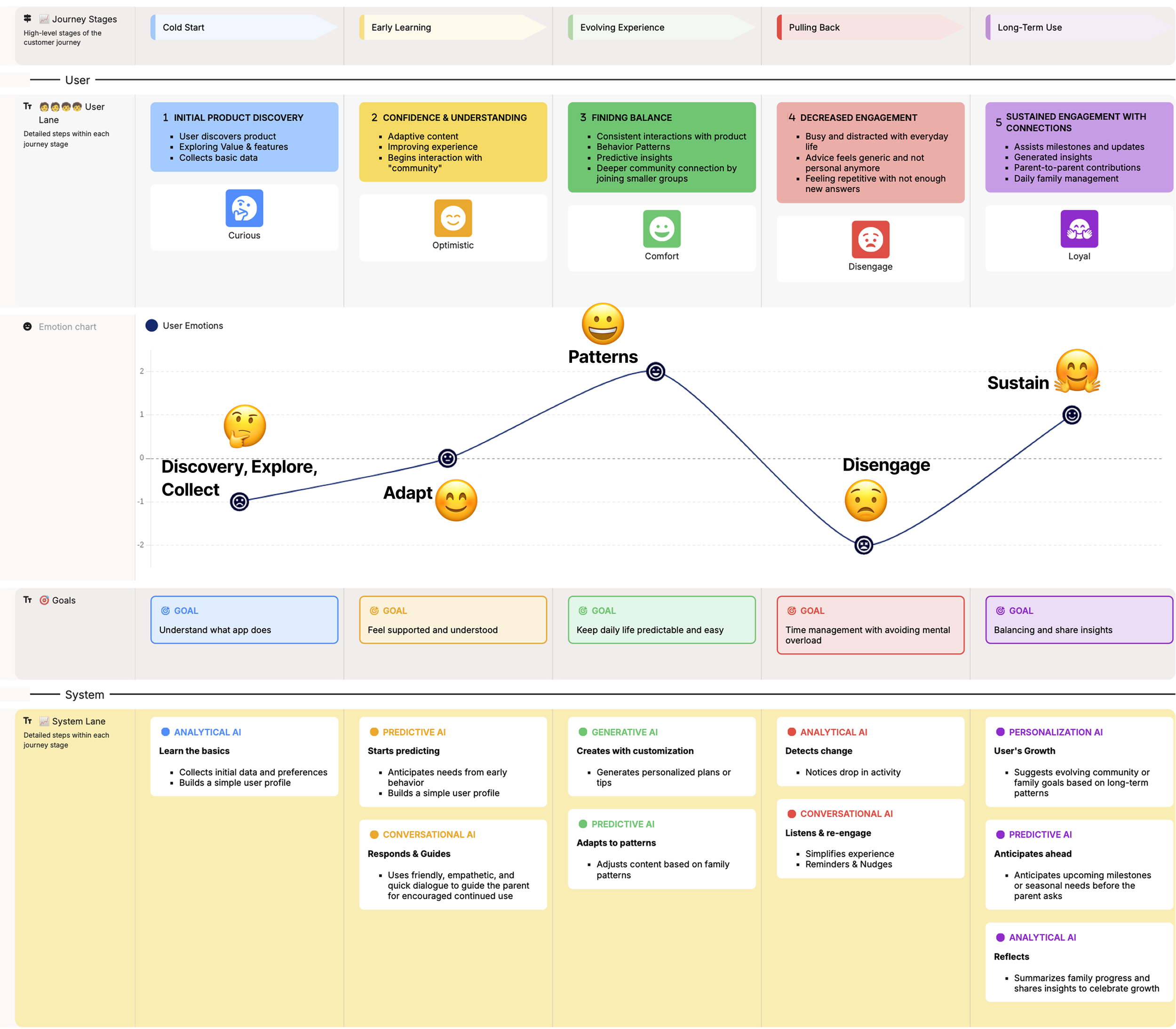
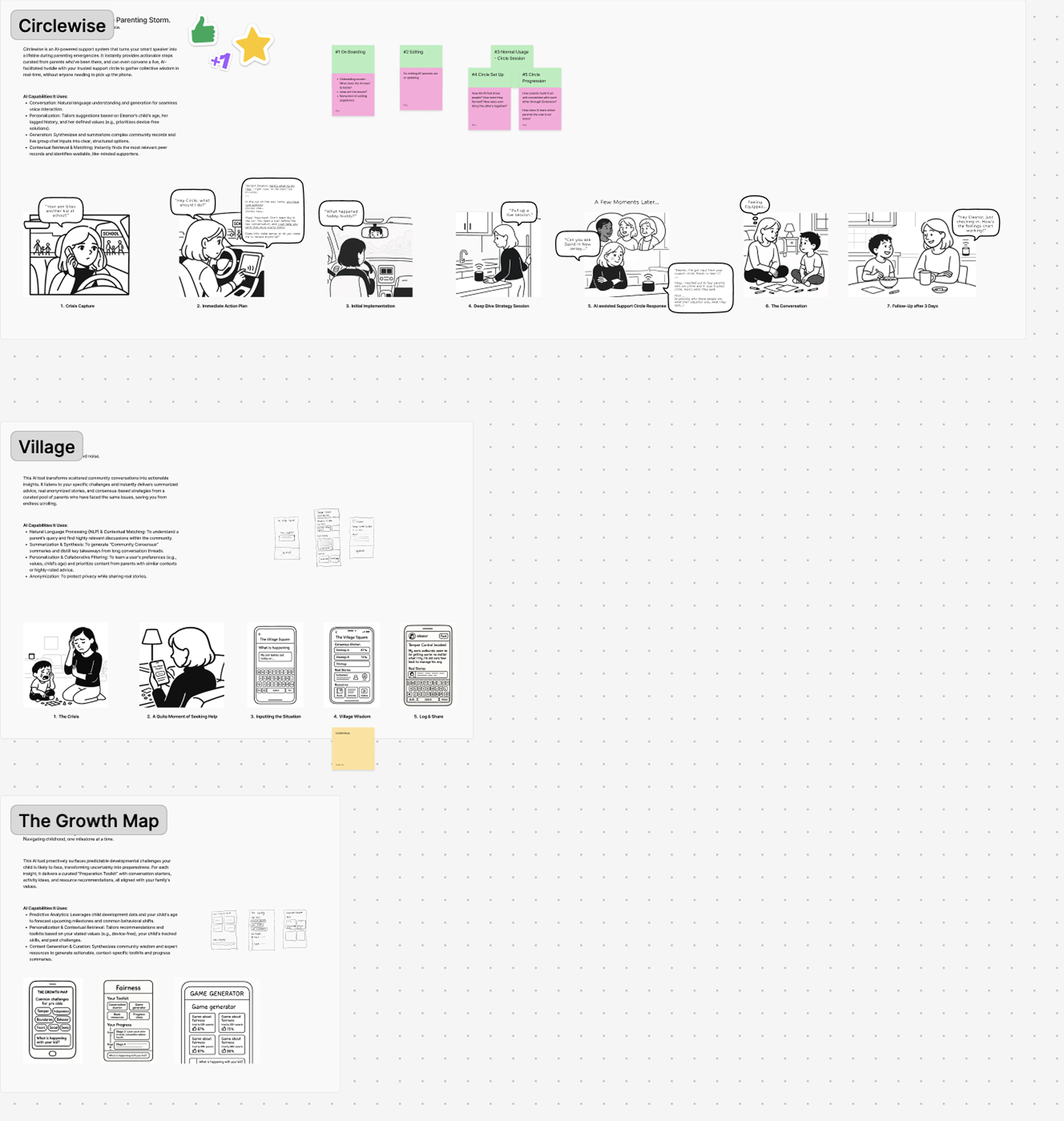
Mapping the “Village” into Daily Life
Before designing screens, we needed to visualize where Circlewise fits into Eleanor’s chaotic routine. We utilized Journey Mapping and Storyboarding
AI-Assisted Wireframing to Design
Accelerating Structure with Figma Make; Iterating & Refining to reach Human Design
To translate these concepts into a tangible interface quickly, we utilized Figma Make. We prompted the AI to generate layouts for different task flows we outline previously.
The Value: Figma Make allowed us to rapidly test information architecture, generating multiple versions of the Home Feed and Profile pages to see what hierarchy felt most intuitive.
The Limitation: While the AI provided a solid structural foundation, the initial outputs felt cold and generic—lacking the specific “trust” cues our research demanded.
Thus, we took the raw AI wireframes into Figma for deep, manual iteration. This phase was about injecting empathy and “humanity” back into the design.
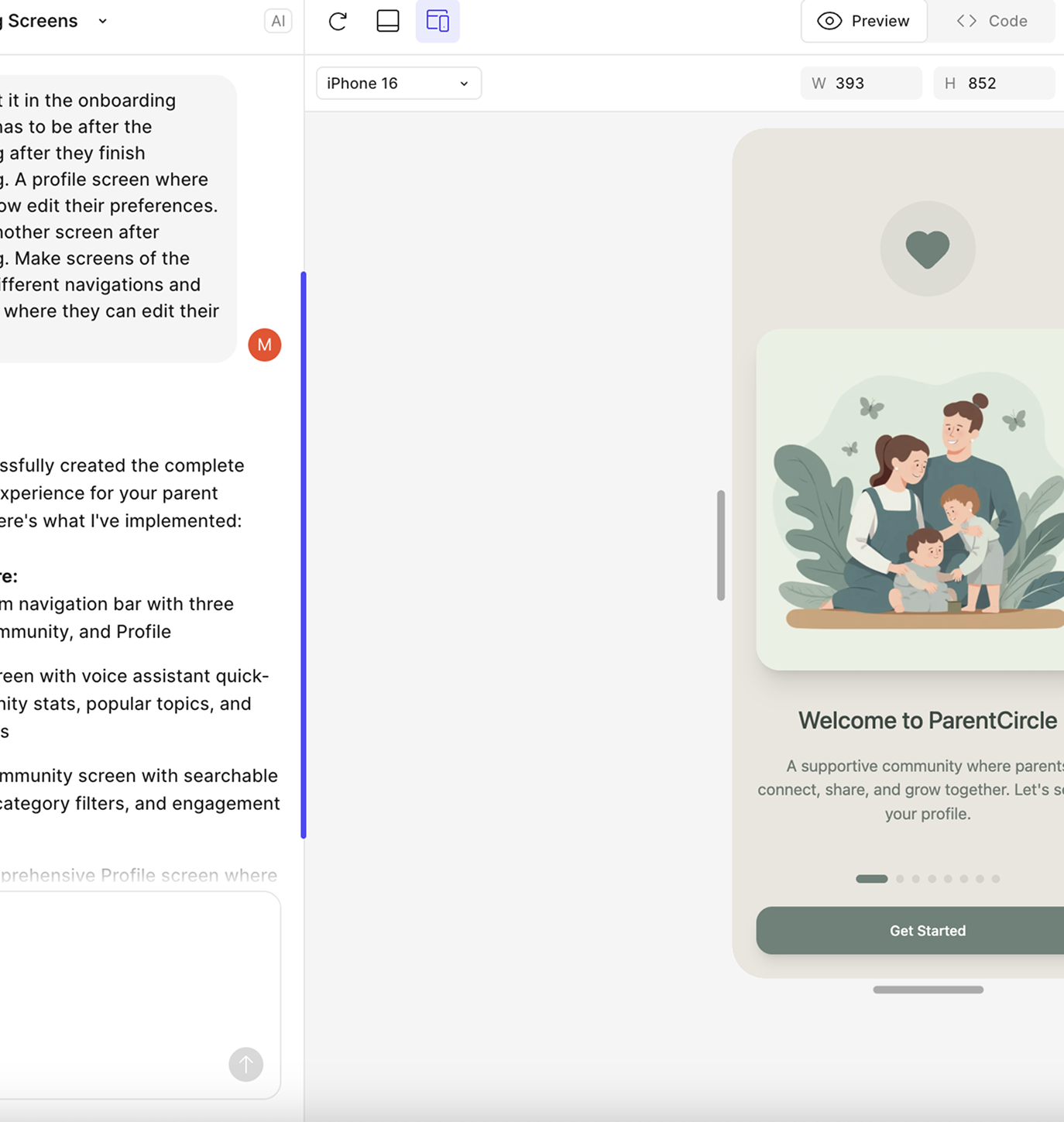
Initial designs on Figma Make
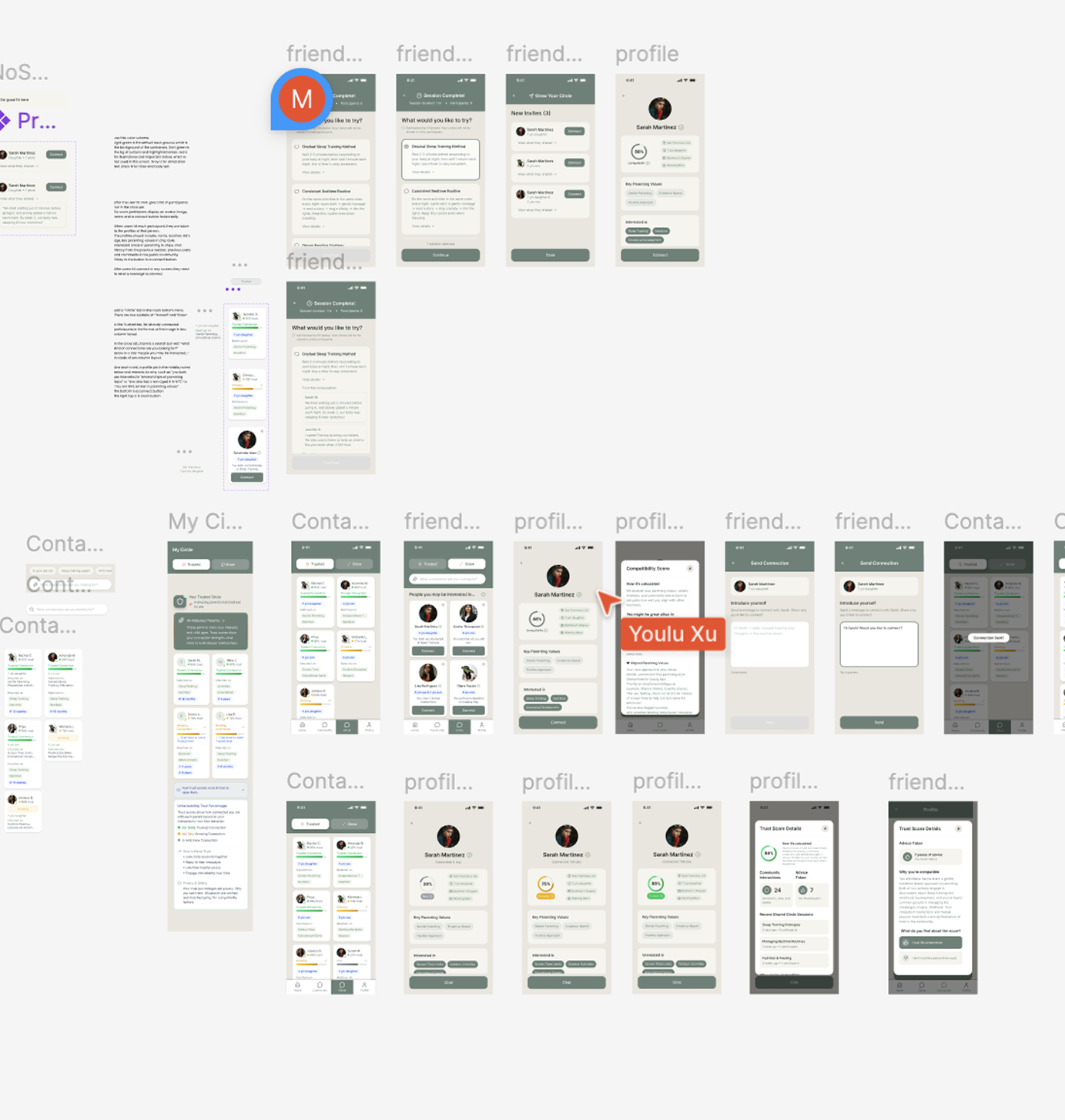
Iterating final designs
Designing for Transparency
One of our biggest UX challenges was: How do we make a digital stranger feel safe?
We developed the concept of a Trust Score. Unlike social media “likes” which measure popularity, the Circlewise Trust Score measures reliability and shared values.
Behavioral Scoring: The AI analyzes interactions for helpfulness and civility.
Explainability: We needed to ensure users understood why someone was recommended.
User Control: Parents ultimately decide who enters their inner circle.
Final Design
Circlewise: Connect, Share, and Grow
Our final interface focuses on calm, clarity, and trusted connections.
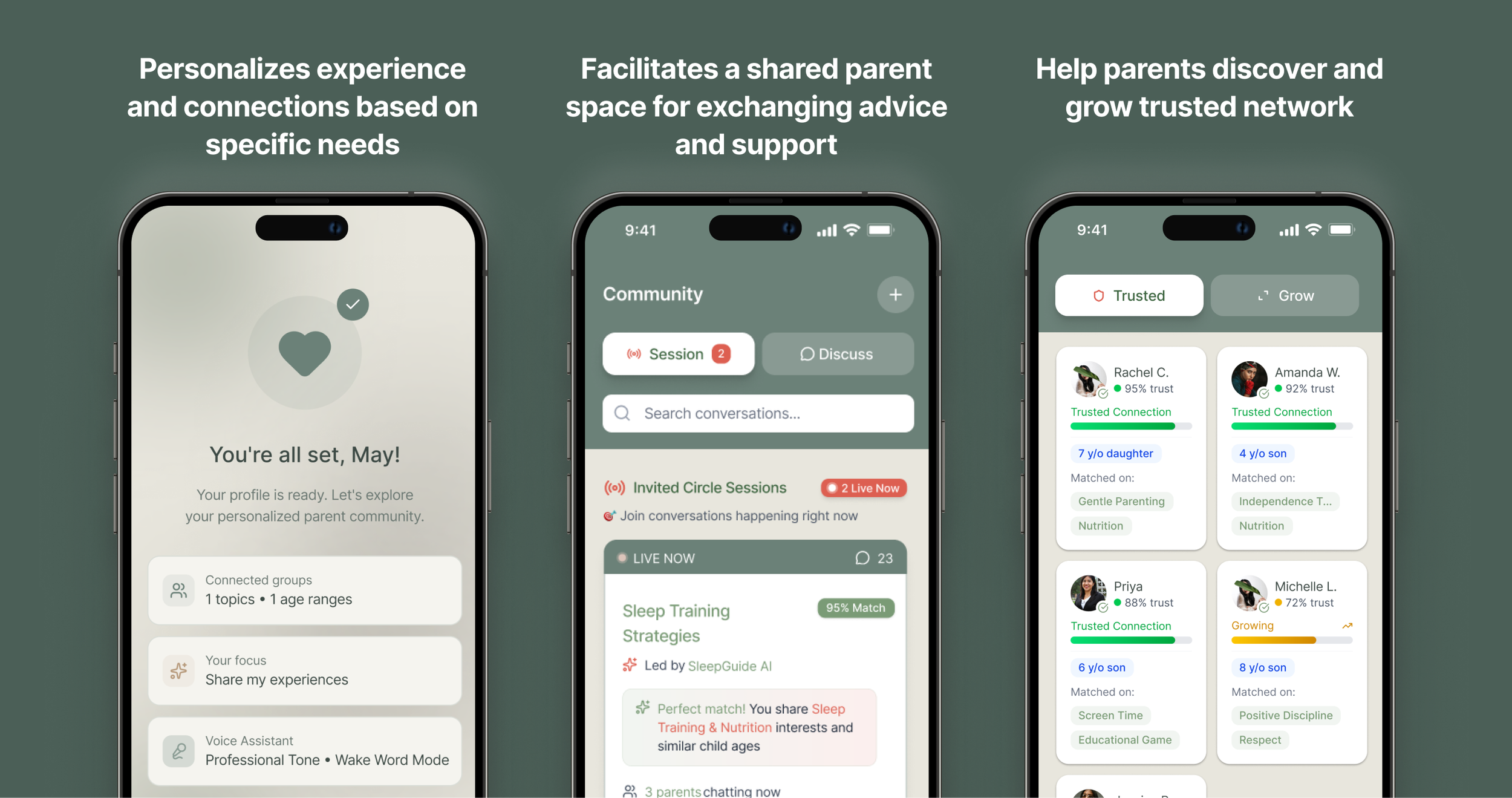
01 Onboarding with Intent
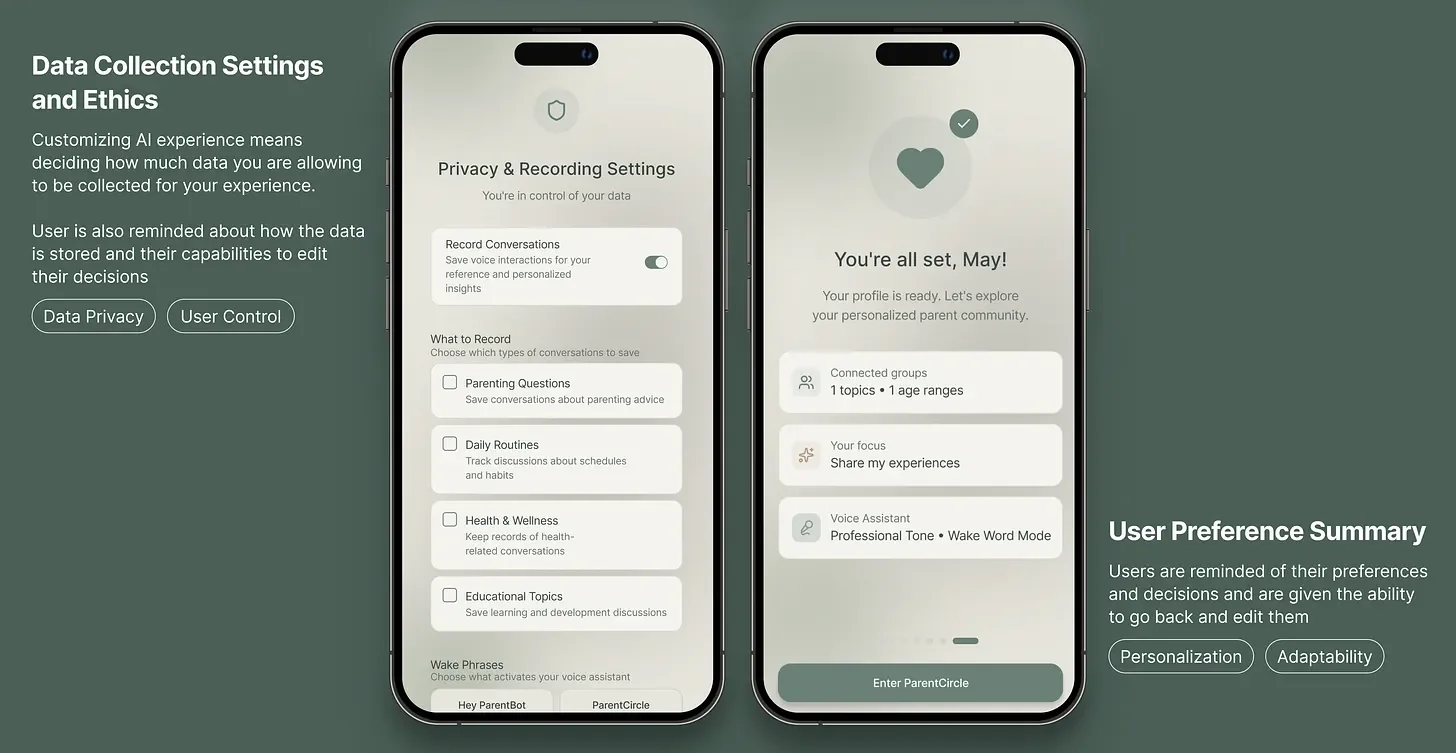
Instead of a generic signup, Circlewise uses AI to build a “Parent Profile” right from the start. By asking about topics (e.g., behavioral issues, education) and age ranges, the system ensures that Day 1 content is immediately relevant.
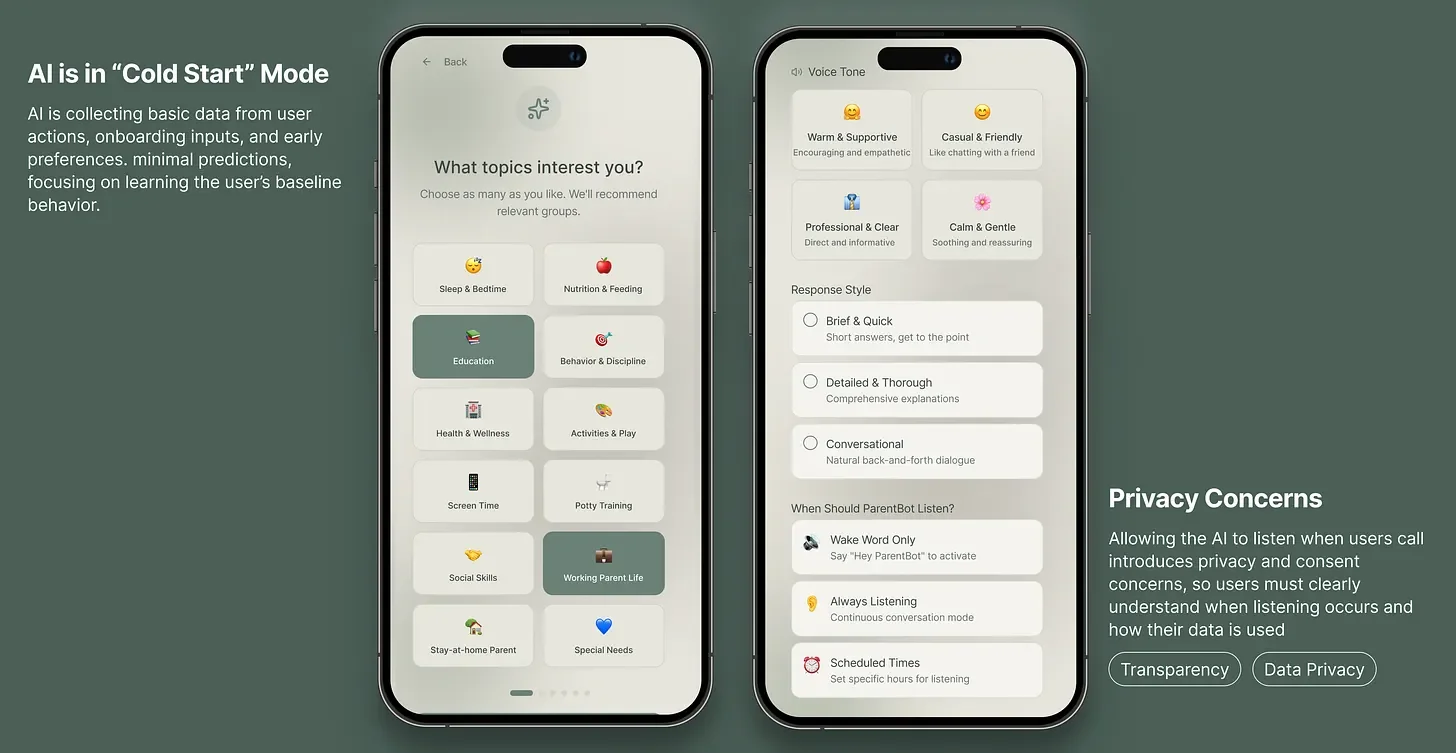
User is first introduced to the product and explore core features, set up their profile, and begin forming an understanding of how the app works.
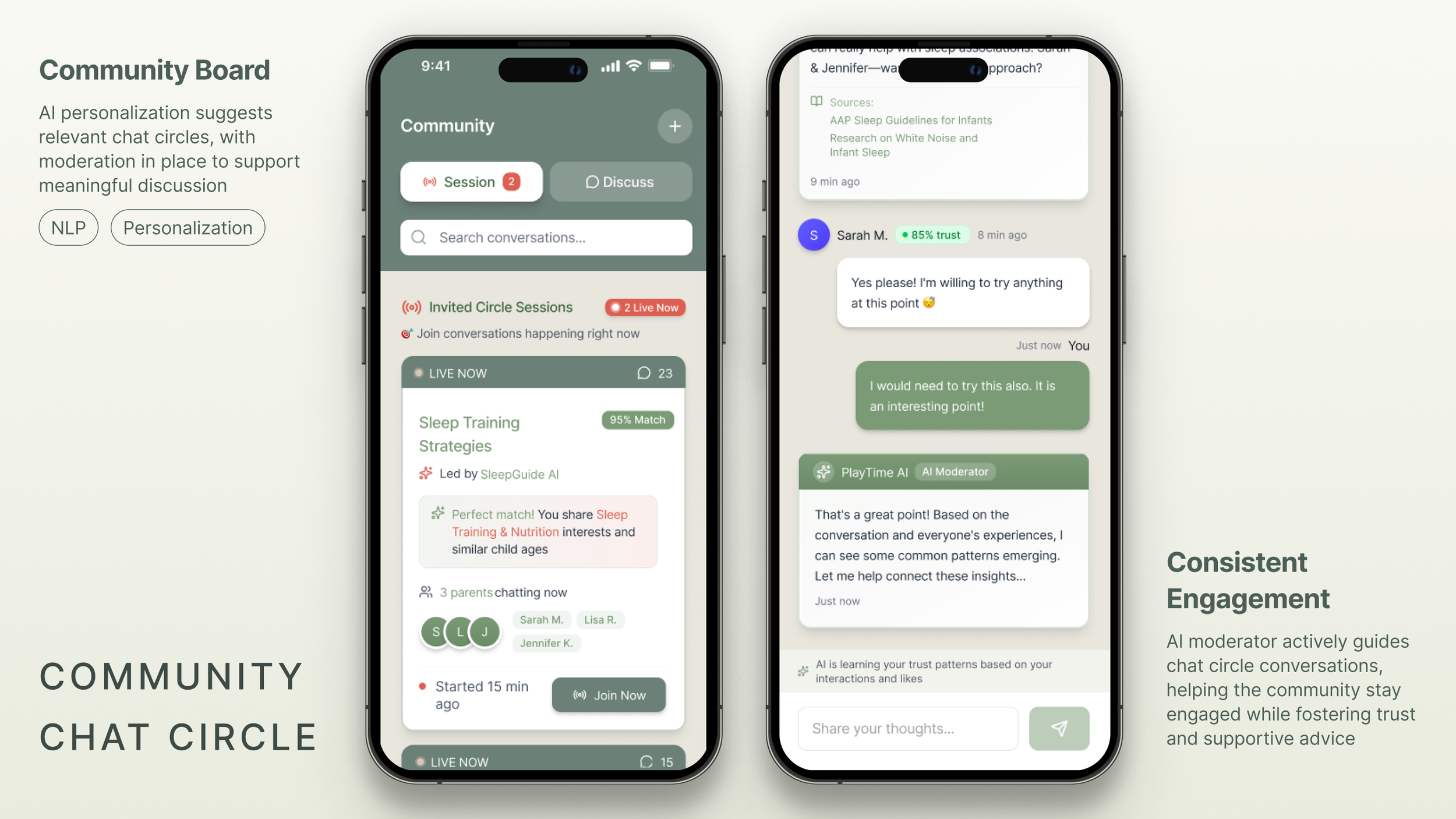
02 Community Chat Circle
As users move out of the Adaptation stage, ongoing use helps them feel supported and optimistic about the experience. Engaging with the community also builds their comfort, preparing them to form deeper connections, including joining trusted, closed chats with other parents.
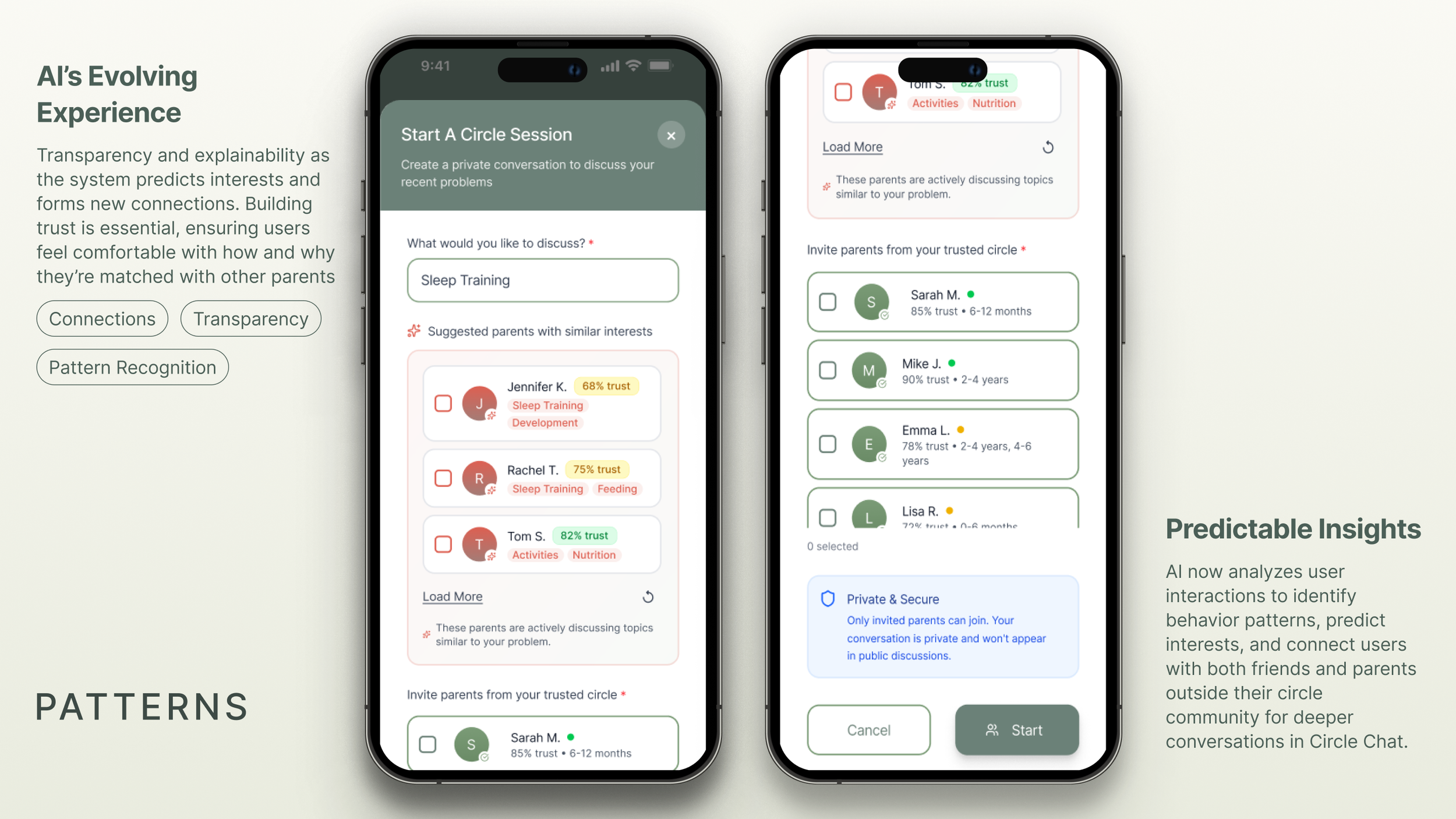
Possible Dip
However, as users grow familiar with the platform, repetitive interactions or trust doubts may lead to fatigue and detachment. During this period, the AI receives fewer signals to learn from.
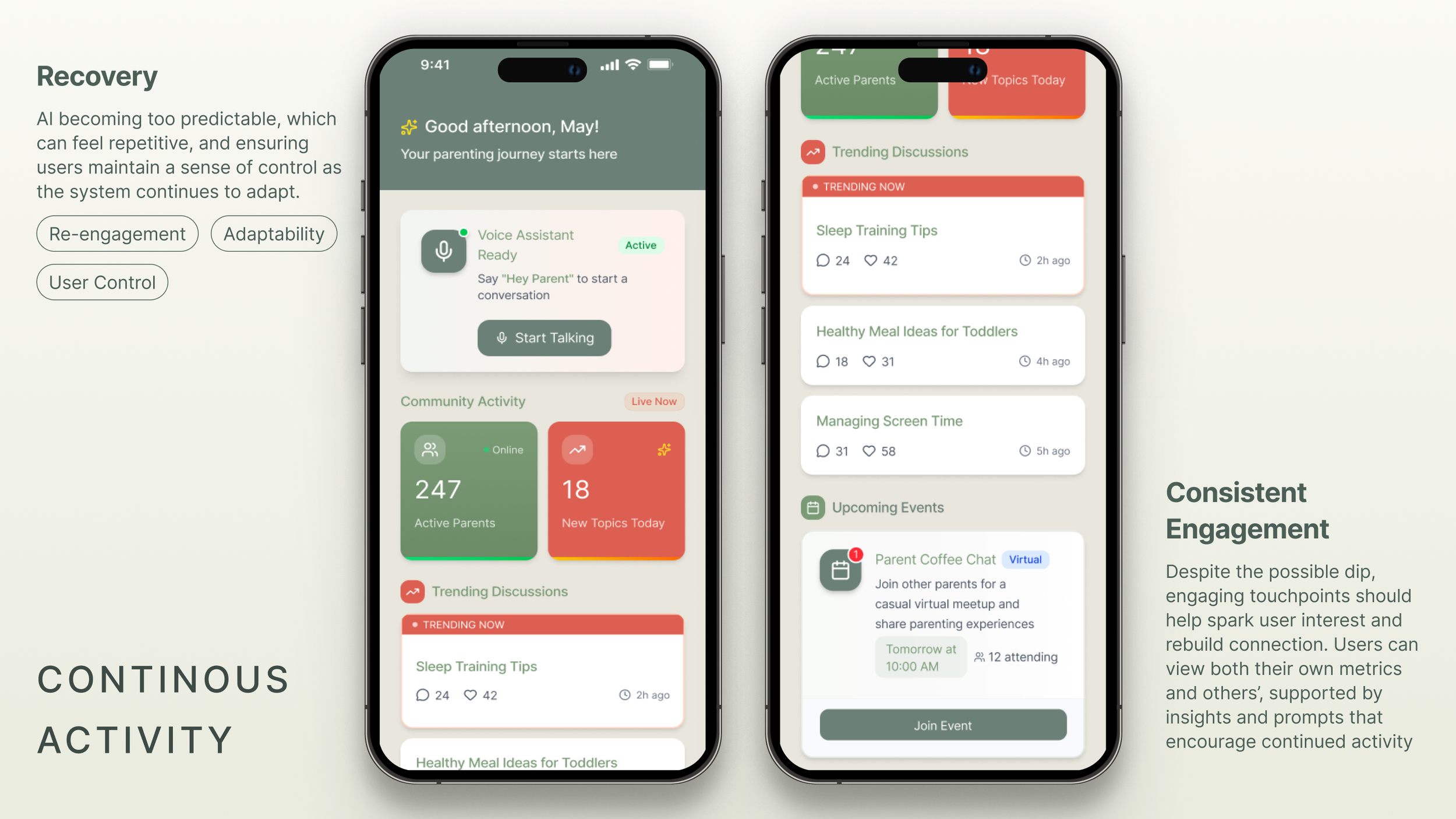
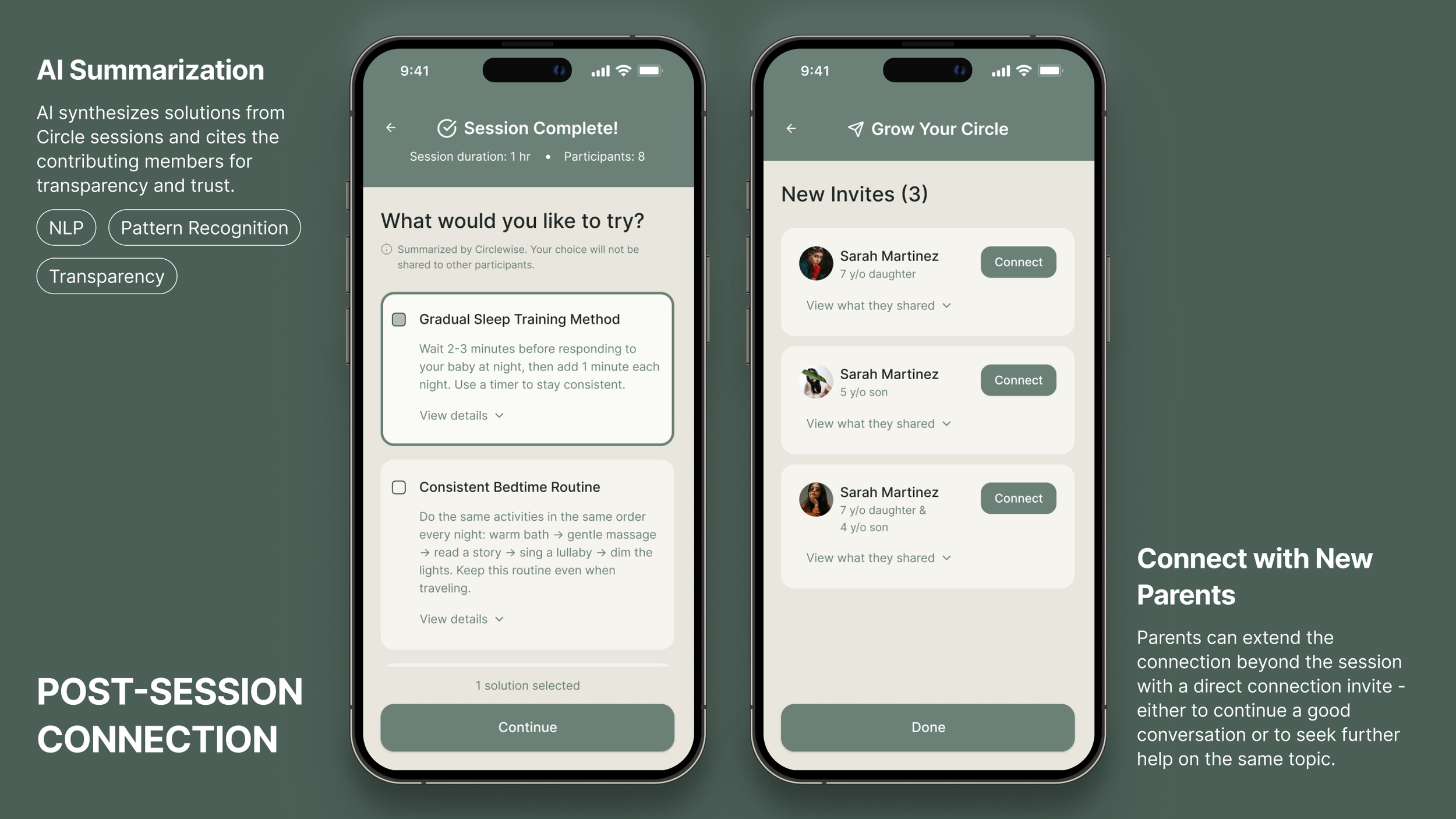
03 Grow Trusted Network
The first step of building Users can either connect with other parents either after a shared chat session.
Future Possibilities
Where Circlewise goes next
Our current design solves the immediate need for connection, but the potential for AI in this space is vast. We envisioned three future pillars:
Advice Repository: Converting ephemeral chat data into a searchable, trustworthy library of parent wisdom, with clear transparency on the origin of the information.
Coached Parenting Support: Interactive AI scenarios that help parents “practice” difficult conversations (e.g., talking to a teacher) with guided feedback.
Family Growth Partner: Evolving from a crisis-management tool to a long-term partner that maps the child’s development over years, spotting patterns that a busy parent might miss.
Reflections
Designing for the “Village”
Working on Circlewise taught us that in the age of AI, curation and intentionality is a privilege and form of care.
We learned that parents don’t want AI to raise their kids; they want AI to clear the path so they can raise their kids better. By focusing on trust, explainability, and community,
“we designed a system where technology can help steer rather than control parent to parent connection.”